
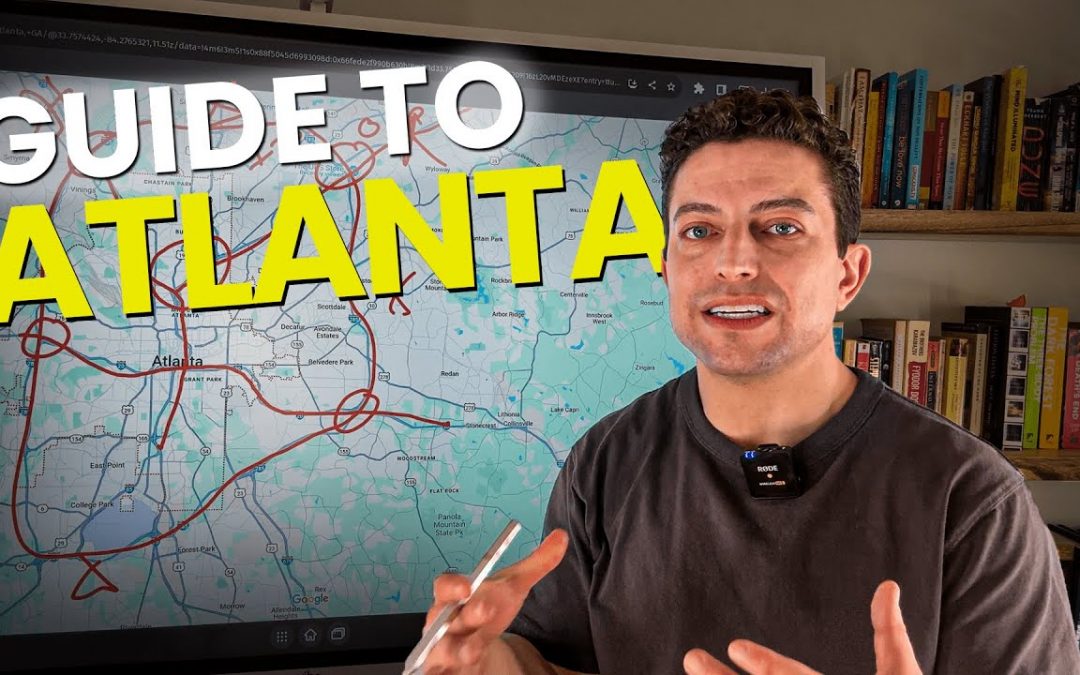
So you’re moving to Atlanta and you don’t know anything about it yet. That is the position most of my clients are in the first time we talk. Metro Atlanta is big, it is spread out, and almost none of it is obvious from a map.
This is the orientation version: how the map works, where the traffic is, what the counties do to your schools and your tax bill, what it costs, and how locals talk about the different parts of town.
One warning first. Atlanta does not break down into neat cookie cutter sections. Things change from neighborhood to neighborhood and street to street, so treat this as a mental map, not a verdict on any street.
The Perimeter, and what ITP and OTP mean
Interstate 285 loops around the city, and locals call it the Perimeter. You are either ITP, meaning inside the perimeter, or OTP, meaning outside it. There is also the actual city limit, which locals get very hung up on even though all of us spend plenty of time outside the city.
Three interstates matter most. I-75 comes down from the Cobb side in the northwest, I-85 comes in from the Gwinnett side in the northeast, and I-20 bisects the city east to west.
Traffic, and which commute is worst
Where 75 and 85 converge is the Connector. There is never a time of day or day of the week when traffic there will not be really bad. The other reliable hotspots are anywhere 285 meets another major highway.
If you work in the city and live in the suburbs, here is how I rank the commutes from worst to easiest: the north side is worst, the Gwinnett side second, Cobb third, directly south fourth. East or west is on average the least congested.
Landmarks worth knowing
Hartsfield-Jackson International Airport sits in South Atlanta, and there is a commercial airport in Chamblee. The most popular shopping district is Buckhead, home to Lenox Mall and Phipps Plaza. Midtown is the commercial and arts district, with the Fox Theatre and the High Museum. Downtown has the aquarium and the Coke museum, but it leans touristy and is not where locals congregate right now.
The Falcons play at Mercedes-Benz downtown, the Braves at Truist Park in Smyrna, and the zoo is in Grant Park. Stone Mountain is a popular year-round hiking spot, and in winter they turn it into Snow Mountain. The Chattahoochee runs through most of the state, and locals float and fish it.
Piedmont Park is our most popular park, and the largest is now Westside Park, which when I filmed this in 2025 was only open in a limited capacity. We are a city in a forest, and that is one of my favorite things about living in Atlanta.
You will need a car, but MARTA is real
Atlanta is not dense. We are sprawled out, and you will need a car here.
MARTA’s bus system covers most of the metro. The heavy rail is limited: gold and red lines running north to south, green and blue running east to west. You need to be a reasonable distance from a station, but plenty of locals get real use out of it, and parking is typically free. The best use is the airport: park at a station and ride in rather than paying long-term parking. When I filmed this in 2025, I believe a one-way ticket was still $2.50.
The Atlanta BeltLine
The BeltLine has been one of the most significant amenities to arrive here in decades, and a lot of locals still don’t really know what it is. It is an old railway corridor, ripped up and paved into a loop inside the Perimeter: a circle within the circle. You can walk, run, bike or scooter it, and it created connectivity between the neighborhoods it passes through that we did not have before.
I own a home in the BeltLine neighborhood of Peoplestown, and from the entrance at D.H. Stanton Park I can head southwest through Capitol View and continue around to the west side. The most popular stretch is the east side, around Inman Park and Old Fourth Ward. Eat lunch in Inman Park, walk it off heading north through Piedmont Park, stop at Ponce City Market, then carry on into Midtown without getting in your car once.
For a city starved for density, that loop has been transformative, and it has moved real estate values in every neighborhood it touches.
Counties, schools and property taxes
Four counties reach inside the Perimeter, and which one you land in affects both your schools and your tax bill.
School quality varies quite a bit within a single county. For what my anecdotal opinion is worth, among the counties people commute into the city from, I put Cobb first and Gwinnett a close second. Gwinnett is known for strong resources around STEM-focused schools and at-risk youth, so you may want to flip that order.
Fulton gets a bad rap overall, but North Fulton schools are often very good while South Fulton schools do not have as strong a reputation. On a lower budget, raising a family and needing good schools while staying reasonable to the city, look at Fayette County. There are also many charter options, though popular ones have a waiting list, and people arriving from either coast are often surprised at how reasonable private schooling is here.
Property taxes change by county, by city, by your age and by other factors. The simplest comparison is the average effective rate: roughly the percentage of your home’s value you pay each year. Cobb was lowest on average, followed by Cherokee, then DeKalb, Henry, Gwinnett, Forsyth, Fulton and Clayton. The swings are not enormous, but you will feel a real difference between Clayton and Cobb.
The weather
Summers are hot and muggy. Winters are short, cold and wet. Temperatures typically vary from 39 to 89 degrees, we get over 200 days of sun a year, and we have four distinct seasons. Coming from the Northeast or Midwest, our winter will be a joke to you. Spring and fall are to die for: mid 60s to low 70s, sunny and breezy.
What it cost to rent or buy when I filmed this
These are 2025 numbers from when I recorded the video, so treat them as a benchmark rather than today’s quote. For current pricing, start here.
Renting, in 2025:
- A single room in a boarding-style house ran about $700 to $800 a month.
- A one or two bedroom apartment to yourself ran roughly $1,500 to $1,800 depending on the area.
- An entire single-family detached home started around $1,900, and we have more of those to rent than most cities.
- Around $2,900 to $3,000, you have your pick of the litter and can rent a genuinely large house.
Buying, in 2025: a studio condo inside the Perimeter, in a decent area, ran in the mid $200,000s or less. Small, dated, and don’t forget the monthly HOA. The better benchmark is the average buyer. For a three bedroom, two bath, single-family detached home of at least 1,400 square feet inside the Perimeter, the average was around $400,000. For something decent with renovations, you wanted at least $450,000. Below $365,000 you were generally looking at worse areas, smaller homes, homes with issues, or homes much further out.
Where the jobs are
A lot of the people I relocate work in healthcare. The CDC and Emory University and its hospital are in North Decatur, and Pill Hill in Sandy Springs is three major hospitals plus thousands of smaller practices. Film and TV is spread out: Trilith in Fayetteville, Tyler Perry Studios, which is essentially all of Fort McPherson in South Atlanta, and studios in Chamblee. In tech, Google and Facebook have been opening up around Midtown and West Midtown. In higher education, Georgia Tech is in Home Park, Georgia State is downtown and spreading south, Emory is in North Decatur, and there are multiple historically Black colleges and universities on the west side.
The airport alone is a huge driver of the economy, Porsche’s headquarters is in that same area, and UPS is just north of Sandy Springs. At least 17 Fortune 500 and over 23 Fortune 1000 companies are headquartered here. The economy is diverse enough to start or accelerate a career in a lot of industries.
The sections of Atlanta, as I see them
I have lived here since 2008, and this is how I divide the map. For more depth, see my guide to Atlanta neighborhoods.
The inner core. Neighborhoods centered on downtown, close to the BeltLine, popular and often expensive: Grant Park, Inman Park, Reynoldstown, Cabbagetown, Summerhill, Peoplestown, Virginia-Highland, Mechanicsville.
Buckhead and Vinings. Over 20 villages of Buckhead take up a big footprint on the north side. Buckhead gets called the Beverly Hills of the South, and that wealth brings high-end retail with it. Vinings next door is also expensive, and notably in Cobb County, which may matter for schools.
The northeast side. Chamblee, Doraville, Embry Hills, Tucker and Northlake. Diverse, great food along Buford Highway, and one of the fastest growing parts of the city. North Druid Hills sits nearby, fairly expensive, with a large Jewish population.
East. Decatur, North Decatur, Avondale and Scottdale, the most established areas on the east side. The City of Decatur is very desirable for its public schools and the walkability of Decatur Square, and expensive because of it. Do not be deceived by a Decatur mailing address: it does not necessarily mean the actual City of Decatur. Scottdale and Avondale I talk about a lot for value while staying close to downtown Decatur. South of there, neighborhoods are gentrifying, especially East Lake, with options in between like Lake Claire and East Atlanta Village.
South. The Tri-Cities: Hapeville, East Point and College Park. These get a bad rap in the media, but I think they are fantastic places to live. Great proximity to the airport, and the value is typically much better than comparable north-side neighborhoods.
West. Neighborhoods bordering the BeltLine are building up faster, so West End, Ashview Heights and Mozley Park have gotten fairly expensive relative to a few years ago. Others are still dealing with real issues including drug activity, places like Dixie Hills and Oakland City. That does not mean there are no good places to live there. It means knowing exactly what is happening on the specific street.
West Midtown. Industrial feel. Blandtown has probably the best food scene inside the Perimeter outside of Chamblee, and a lot of the Michelin-starred restaurants awarded went to Blandtown and West Midtown. Good high-end shopping at Westside Provisions District.
The southeast quadrant. Much less dense, and in many spots it doesn’t feel like the city at all. You may read scary things about places like Gresham Road, but I cannot tell you how many quiet, well-kept subdivisions I have been in over here, full of retired professionals and working-class families, that I would have no issue living in. Some great mid-century modern communities too, and your dollar goes further.
Camp Creek. Google it and you will find bad reviews. In reality it is lively, with a lot of townhome, condo and single-family new construction, and probably the highest concentration of good shopping on the south side. A great fit for clients on a lower budget who want new build.
How to actually narrow it down
Do not cross a neighborhood off your list because you read something scary on the internet. Build your list of priorities instead: commute, budget, proximity to an amenity or to friends and family, and the vibe you are after. You want your family to feel safe, and there are great places to live in every single part of Atlanta. Then do the legwork on the street itself: how homes are maintained on that block, how it feels at different times of day, and what the neighbors say.
If you need help relocating to the Atlanta area, whether renting or buying, this is what we do and it is why I make these videos. We are a real estate company focused on relocation, and we have done this as much as any other realtor group in Metro Atlanta. Book a free consultation and we will get on a Zoom call and make a plan.