
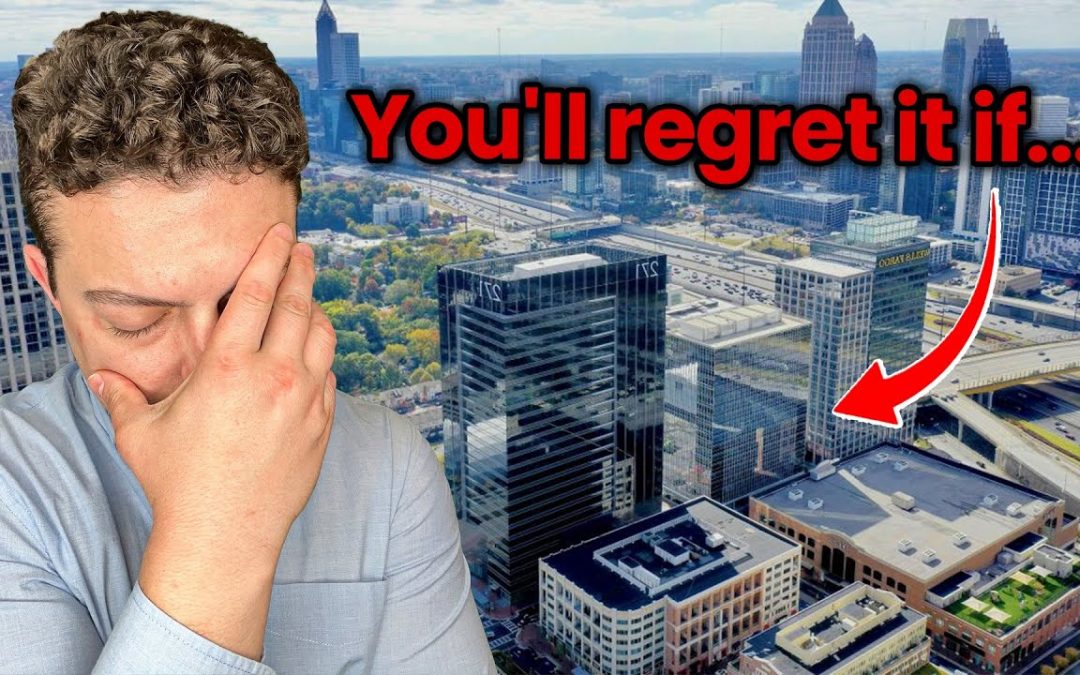
I love Atlanta. My whole YouTube channel is about what it’s like to live in the Atlanta area. But if you’re choosing between Atlanta and another major metro, you should hear the not-so-great parts too, so you can make the right decision. This post covers my three biggest reasons not to move to Atlanta in 2026, taken from a video I published in January 2026.
These are not the minor complaints you always hear, like the extremely humid summers, the mosquitoes or the cockroaches. They are the three things that, in my opinion, will have the biggest impact on your lifestyle here. If none of them is a big issue for you, Atlanta really might be the best place for you and your family. If you’re planning a move, see my relocation page.
Reason 1: Atlanta No Longer Offers the Value It Used To
When I got into real estate and started making videos about Atlanta in 2019, the Atlanta metro was one of the most relocated-to metros in the entire country, year after year. For good reason. A starter home budget at that time was around $280,000, and you could rent a nice apartment in one of the newer buildings for around $1,100 to $1,200. Atlanta was a lot of city for what it cost to buy a home here.
Fast forward to 2026, as of when I filmed this in January, and overall home prices have increased 60%. Here is what that does to a starter budget:
- Inside the perimeter: To find something move-in ready in a decently established area, your starter home budget is going to be at least $400,000. “Inside the perimeter” (ITP) means inside the I-285 highway loop that rings the city.
- Top public school suburbs: If you have kids and need to be in one of the suburbs with some of the highest rated public school systems, that starter budget is probably closer to the low $500,000 range.
I also tour homes all over the metro throughout the week, and a lot of them are not updated. I rarely walk into a home that has been significantly updated and remodeled throughout the entire property. Many homes are extremely well-maintained and move-in ready. But at the prices I just mentioned, you would hope you’re not buying a home with all of the finishes original to when it was built, and that is very often the case.
Going out costs a lot too
Setting aside the cost to rent or buy, Atlanta is a ridiculously expensive city when it comes to going out, whether it’s a restaurant or a cocktail bar. It cost me almost $150 for a night of bowling the other night. For whatever reason, the cost of going out, whether eating or some other date night experience, is on par with much larger cities that have way higher amenities to offer.
Incomes haven’t kept pace with the cost of all of this. Depending on your industry, your salary is likely to be a bit lower here than in a larger metro, and yet you’re typically paying larger-metro prices in many ways.
The other side of the value argument
Don’t get me wrong. There is still an excellent value proposition in Atlanta. If you know where to look and how to look, you can get what I think is a very good deal when purchasing a home. We also still have a diverse, thriving economy, a mild climate with four distinct seasons and no natural disasters, and way more convenient travel than average, thanks to all the direct flights out of Hartsfield-Jackson and Atlanta being a Delta hub.
But the sad fact is that Atlanta is no longer an area where you can buy or rent shelter at an extremely good value for what this city has to offer. For the buying process, see my page on buying and selling a home in Atlanta.
Reason 2: Atlanta Resists Urbanization
If you want to live in a big city and you’re choosing between a few, I’m guessing you’d like somewhere that is highly walkable, has efficient and extensive public transit, has extensive and well-thought-out bike lanes and even sidewalks, and has a clear vision for the future that adapts to a large influx of people. Unfortunately, none of those accurately describes the current situation in the Atlanta area.
Traffic, and the NIMBY problem
It seems everyone here likes to complain about the insane traffic, the lack of walkability and the unattainable home prices. But when it comes to voting on these topics, the NIMBY (“not in my backyard”) mentality takes hold.
Instead of expanding MARTA, the Metropolitan Atlanta Rapid Transit Authority, and its heavy rail out into suburban areas like Cobb and Gwinnett County, our answer to the insane traffic has simply been to add more lanes to the highways, which we all know is not a real solution. The suburbs around Atlanta’s perimeter benefit from the city and all the income it brings in, in a myriad of ways. And yet it seems none of those places want to allow Atlantans to easily go in and out of them.
We do have MARTA and we do have some light rail, but it is extremely limited. The number of people who could realistically live here without relying on a car is very, very few.
Zoning and density
The Atlanta Belt Line has been a fantastic urban development. However, it is currently facing a lot of backlash over what it was originally intended for, which was light rail.
Everyone here talks about the crazy increase in the price of homes. But when it comes to local voting, it seems no one wants to allow the zoning changes that create more density, which is really what you need at the inner core of any major city. Local residents lament the transformation of empty parking lots that hold a special place in their hearts, because those lots get built over with multi-use developments, which, to be fair, are often overpriced. But any increase in the supply of places to live will gradually bring the overall price of purchasing homes in the city down.
In my experience living here, there is a general negative sentiment about urbanization projects that would directly address the issues you hear most residents complain about.
Promises that don’t get delivered
It seems every mayor that passes through has big plans and lots of promises, but ultimately fails to deliver meaningful projects that would affect traffic, density, the cost of living or overall quality of life. Not too long ago, Atlanta’s sales tax increased to fund the More MARTA program. To date, MARTA has failed to deliver on any of the major projects it said that increase would allow.
There has been a significant increase in bike lanes throughout many parts of the city. However, Atlanta remains a harrowing place to bicycle on a regular basis. In my opinion, it is flat-out extremely dangerous. And if you’ve ever driven through the neighborhoods and subdivisions inside the perimeter, you’ve probably noticed that many of them don’t even have sidewalks.
So if you’re looking for a bastion of progressivism and urbanization projects that actually improve people’s day-to-day lives, Atlanta may not be for you. If walkability is a priority, see my list of the most walkable neighborhoods in Atlanta.
Reason 3: Atlanta Is Expensive and Corporate
If you pay the prices to buy or rent a home that are in line with other major American cities like Chicago or Dallas, you would expect the same level of amenities, restaurant quality and things to do as those cities.
Atlanta does have an endless amount of very fun things to do. However, in my opinion, most of the best things we have to offer revolve around outdoor activities and festivals. When it comes to the food and drink scene, or the more common staples like a Braves game at the Battery, the aquarium or the botanical gardens, the prices simply do not line up with the value on offer.
The city of franchises
On food and drink specifically, we have a lot of corporate chains here. This is not the city to find a lot of mom and pop restaurants. We do have those, but any new development you see is going to be filled with the same six, seven or eight businesses. To be fair, those are often the type of businesses that are needed, whether it’s a bank or a MinuteClinic. But from my perspective, this really is the city of franchises.
If you go out on a date night in Atlanta, you are often going to pay close to New York City restaurant prices, and you are almost certainly not going to get the same value for those prices. If I’m going to spend serious cash on a date night, I at least want to feel like I’m getting good value for my money. Too often that is not the case.
Where the value still is
We do have bastions of good value and high quality, like Buford Highway, which is honestly one of Atlanta’s saving graces when it comes to the food scene. But for fine dining, and for just average dining, going out to a pub, a mid-level restaurant or one of the more popular Atlanta attractions, be prepared to pay prices that are typical of much larger cities that have a higher quality of amenities on offer.
There are so many fantastic things to do on a night out in Atlanta. But in my opinion, it’s way too easy and common to spend a significant amount of money on a very mediocre experience.
So Should You Still Move to Atlanta?
Those are three reasons you may not want to move to the Atlanta area in 2026. If none of them really bothers you, then fantastic. This really could be the place for you. There is a very real, significant value proposition here: a diverse, thriving economy, a mild climate, incredible nature and a hub for travel. So don’t let this video discourage you. It is a fantastic place to live for many different reasons. It’s just important that we’re honest about what’s not so great, so you can make the best decision for you and your family.
If you want a longer look at the tradeoffs, I cover four downsides in moving to Atlanta downsides.
I’m a local realtor, and all I do is help people relocate here from other states. That is my niche. If that sounds like you, book a Zoom call with me. There is no cost. I’d love to help you and your family find the perfect neighborhood and house. You can also learn more about me.