
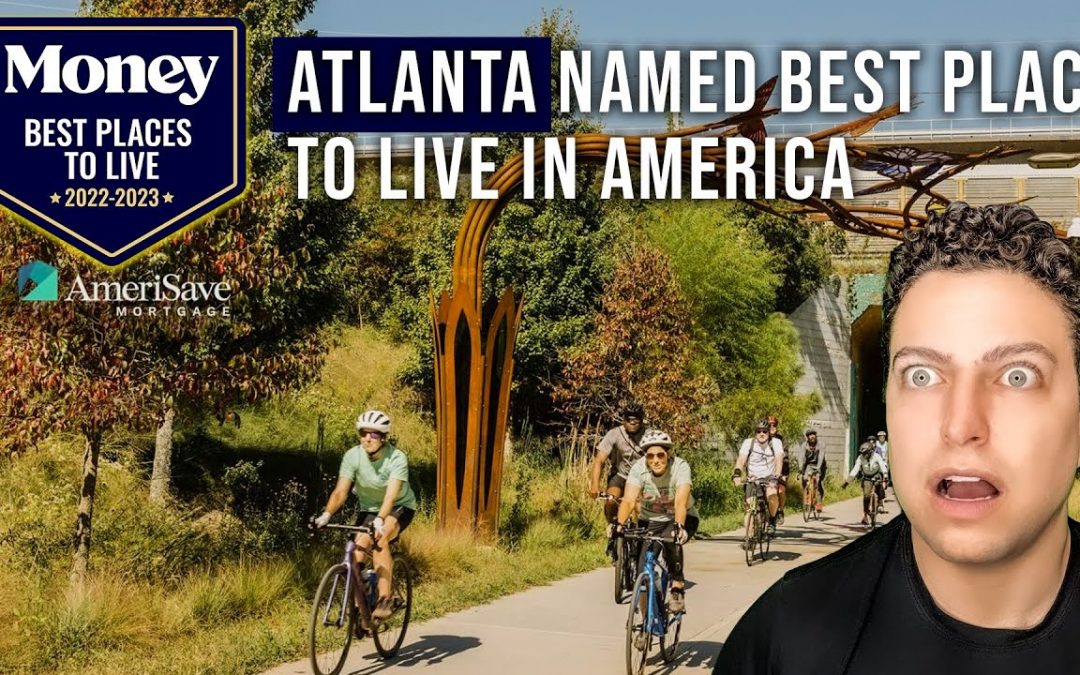
In the fall of 2022, Money.com named Atlanta the best place to live in the US. I’ve lived here for 14 years and my business is here, so I was glad to see it. But when I went through the article, some of it was right, and some of it was wrong in the way articles about a city usually are when the writer hasn’t spent much time there.
This post goes through that article point by point. I’ll tell you what I think holds up, what I think you should ignore, and whether Atlanta really is a great place to live. If you’re thinking about relocating to Atlanta, this is the local view. Everything below reflects what I said when I filmed this in October 2022.
Don’t Get Too Caught Up in City Rankings
First, these lists are arbitrary. When I filmed this, I looked up the US News ranking of top cities to live in, and Atlanta wasn’t even in the top 40. If a city isn’t on a list, that doesn’t mean it isn’t a good city. If a city is in the top 10, that doesn’t mean it’s a great place to live. A ranking is someone’s opinion.
What Money.com Got Right: Belonging
The main thrust of the Money.com article is that Atlanta is a place where anyone can feel like they belong. I don’t argue with that. I think we’re far from being a true melting pot like New York, and we’re not the most diverse city, but we do have a lot of different cultures here. We’re also a progressive city. For the most part, I agree that anyone, or at least most everyone, can feel like they belong here.
How Big Is Atlanta? The Population Problem
The article points out that Atlanta isn’t a massive city. Population-wise, it says the city hovers right below 500,000. This is the point that grinds my gears the most, because people don’t really know what “Atlanta” means.
That figure is true statistically for the city of Atlanta. But when you live here, you don’t sort things into inside or outside the city limits. You use the perimeter, which is Interstate 285, the loop around downtown. For practical purposes, you either live inside the perimeter (ITP) or outside the perimeter (OTP).
The city of Atlanta is only a portion of what’s inside that loop. Other places inside it include East Point, College Park, North Druid Hills, Brookhaven and Vinings. I don’t have exact data, but adding up those populations, I’d guess around a million people live inside the perimeter, give or take. For comparison, New York City has about 8 million people. New York being about seven times larger than Atlanta in practical terms feels right to me. The article would have you believe Atlanta is similar to Kansas City or Omaha. Statistically that may be true, but Atlanta does not feel like a small city.
The other point of confusion is the metro population. Metro Atlanta is absolutely massive, with dozens of counties that are nowhere near the city, and most people who live in metro Atlanta don’t live in the city of Atlanta. The metro population is closer to 8 million, but that isn’t a practical number if you’re living here. You can’t compare the city of Atlanta to Jasper, which is very rural.
To see how the areas break down, start with our guide to Atlanta neighborhoods.
Civil Rights History and Black Atlanta
The article says Atlanta is the fourth largest Black-majority city in the US and the hometown of Martin Luther King Jr. I want to point out that this is one of the biggest things Atlanta has going for it. I’m not Black, so I’m keeping my opinions limited here. But I have to imagine that if you’re a Black person looking for a place to start a career or move your family, Atlanta has to be high up your list.
I’ve lived in Massachusetts, New York, Connecticut, Baltimore, and now Atlanta. In no other city where I’ve spent significant time have I seen Black people thriving at every level of the community: entrepreneurs, successful business people, artists, celebrities, and normal working-class people.
The civil rights culture is a huge part of the city. The history of Atlanta is the history of the civil rights movement, and it goes well beyond the Martin Luther King museum, where you can visit the house he grew up in. Selling real estate here, I see how many homes, especially closer to downtown and on the West Side, have an incredible history connected to the civil rights movement.
Where the Article Reads Like an Outsider Wrote It
The article says the city has America’s largest puppetry museum and America’s only trap music museum. Both are technically true. But if I were listing the great things to do in Atlanta, I don’t think the puppetry museum, no disrespect, would make the list. Here are a few more places where the article is technically true but misleading:
- Baseball. The article says Atlanta has professional baseball. But if you use the article’s own definition of the city, the city of Atlanta doesn’t have baseball. The team plays in Cobb County now. We have a baseball team, but not inside the city.
- Biking. The article mentions an ever-expanding network of bike and walking trails. That’s technically true, especially for walking trails on the BeltLine. But Atlanta is a horrible city for bikers. You have to be a brave person to ride a bike here, and bike lanes are just now getting more common in the most trafficked areas.
- Food. The article compares Atlanta’s food and music scene to places like Rogers Park in Chicago and Columbia, Maryland. Music, for sure. Food, that’s being very generous. I don’t think we should be mentioned in the same breath as Chicago for food, and I’m just being honest about that.
Atlanta’s Job Market Is Strong, and the Economy Is Diverse
The article says Atlanta’s labor market is exceptionally strong, that the unemployment rate is lower than the national average, and that tech jobs are driving much of the growth. That matches what I say on this channel all the time. For more on that, see my post on where the jobs are in Atlanta.
The key point is that Atlanta has a diverse economy. We’re not built on one industry like coal or shipping, where if that industry takes a dive the city goes into a recession. We have shipping, medical, tech, TV and film, education and banking, and many other industries. When I filmed this, about 17 companies headquartered here were in the Fortune 500, and 22 or more were in the Fortune 1000.
Why Big Tech Keeps Coming to Atlanta
The article mentions that companies like Microsoft, Google and Facebook now have a second headquarters or some kind of presence in Atlanta. Nobody talks about why. I recently read a CNBC article titled “Atlanta is a growing hub for top tech companies like Apple and Microsoft to find Black talent.” It quotes Visa’s diversity chief, Michelle Gethers Clark: “We know that our customer base at all levels includes the Black community and we are not shy about wanting the Black community in our workforce.”
That’s the heart of it. These big tech companies want more diverse top tech talent, and Atlanta is where that talent is. We have Georgia Tech and Georgia State, and we also have historically Black colleges and universities like Spelman, Clark Atlanta and Morehouse. It isn’t only that we have good universities. We have probably the best, largest pool of diverse tech talent for these companies, and that is one of the major drivers of the economy here and of Atlanta’s growth.
The Downside: Rising Prices and Displacement
The article is honest that Atlanta isn’t perfect. It says rising prices have had an outsized impact on the city’s most vulnerable residents and have made it harder for legacy Black families to afford to live comfortably. That is true, and the problem was getting worse when I filmed this.
As a real estate agent, I’ve seen prices rise in the city, and I’ve seen poor people, in most cases poor Black people, forced outside of the city. Some can’t afford the property taxes anymore, some get an offer from a big developer they can’t refuse, and some just can’t afford to live in the city. To the credit of the last two mayors, there are significant affordable housing initiatives, but this is an ongoing problem without one simple answer.
My view is that as a city we’re going to have to get more dense and build a lot of affordable housing to protect against the rapid growth that will continue. Otherwise it gets like Seattle or Silicon Valley, with the disparity you see in San Francisco: extremely rich people and homeless people living on every street. Nobody wants that.
The article also says Atlanta has a 7-acre food forest and 21 farmers’ markets in Atlanta proper, most of which accept food stamps. That’s all true. But it gives the impression that people aren’t struggling for food, and that isn’t the case. Quite a few areas, particularly West and South Atlanta, are still designated food deserts. That means grocery stores and basic essentials aren’t close enough for people to access easily, which is a real problem for poorer people who have transportation challenges.
Culture: Real, but Also Corporate
The article quotes someone saying Atlanta has the perfect blend of culture. Personally, I’m a little critical here. Atlanta has culture: the civil rights movement, deep roots in all kinds of music including rap and trap, and a city rooted in entrepreneurship. But it’s also very corporate. Half the restaurants you see didn’t start in Atlanta. They’re chains from the Carolinas or another state.
There’s a bit of blandness to how Atlanta has grown over the last 10 years. Compare it to New Orleans, where the culture seeps into every step you take and the city eats, sleeps and breathes jazz and seafood. It’s more palpable there. That’s my own perspective.
So, Is Atlanta the Best Place to Live in the US?
It could be. Personally, I don’t think it’s the best city in the country, and there are a few others I like better. But it has grown on me every year I’ve been here.
Two things keep Atlanta from becoming another Silicon Valley of the South, Seattle or San Francisco, in my view: the public schools still aren’t quite good, and crime hasn’t been gotten under control. There’s a lot of gun violence here. I probably would prefer to live in a city where you at least need a permit to own a gun, and I’m tired of the unnecessary gun violence. But I also don’t think it would be good if the floodgates opened and you needed to be a millionaire to live in the city overnight.
On the plus side, it’s a beautiful place to live. We have incredible nature and green spaces, rivers, mountains, hiking trails, parks and botanical gardens. It’s truly an amazing place if you like the outdoors. We also have all the sports teams, fancy restaurants and bars, and funky little things to do if you have a niche hobby. We have a very mild climate, no natural disasters, a diverse economy, a relatively low cost of living (as I described it in 2022), and a lot of room to grow.
Whether Atlanta is the best place to live in the US, I’ll leave up to you. For more on what living here is like, read what it’s like living in Atlanta, and when you’re ready to talk through your own move, get in touch and we’ll book a call.